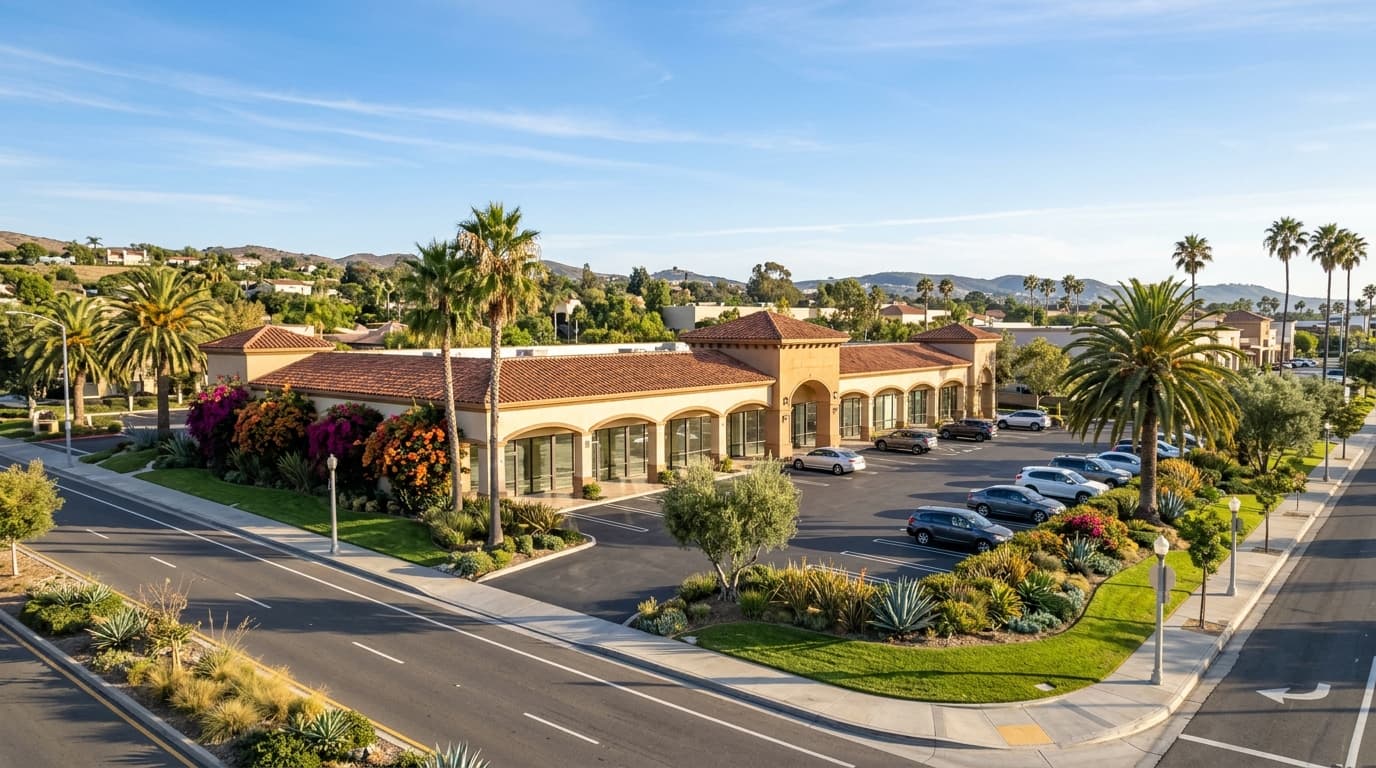
Commercial Real Estate Opportunities for Private Capital
Private investors are looking beyond residential toward commercial assets. Learn how to screen opportunities, understand lease risk and decide what belongs in a Southern California portfolio.
Many private investors reach a point where residential holdings are no longer the whole plan. They want income that rests on leases, longer terms and professional tenants. Commercial real estate can offer that, but it also asks for more analysis, more patience and more detail than a house does.
Here is a practical framework for looking at commercial opportunities in Southern California.
What Makes Commercial Different
Commercial properties are valued largely by the income they produce, not by comparable home sales. That changes how you evaluate them.
- Lease structure matters. The terms of each lease define your income, your costs and your risk.
- Tenant quality matters. A property is only as stable as the businesses occupying it.
- Operating expenses are shared differently. Many leases pass certain costs to tenants, but how much depends on the lease type.
- Value links to income. Small changes in net income can have a large effect on value.
Common asset types include retail centers, small office buildings, industrial or flex space and mixed-use properties. Each has its own demand drivers and risks.
The Numbers to Understand
You do not need advanced finance to read a commercial deal, but you do need these terms:
- Net operating income (NOI): income after operating expenses, before debt payments.
- Capitalization rate: the relationship between NOI and the property's price, often used as a quick comparison tool.
- Debt service coverage: whether income comfortably covers loan payments.
- Vacancy and rollover: how many leases expire soon and how hard they would be to re-let.
- Capital expenditures: roofs, parking lots, systems and tenant improvements.
Ask for actual operating statements and rent rolls, not only projections, and have your accountant review them.
A Due Diligence Checklist
Before moving forward on any commercial property, work through these steps:
- Review every lease, including renewal options, rent escalations and termination rights.
- Confirm the rent roll against the leases and tenant estoppel statements.
- Examine two or more years of operating statements.
- Order a property condition assessment and environmental review where appropriate.
- Verify zoning, permitted uses and any pending code issues.
- Review title and survey for easements or encumbrances.
- Estimate near-term capital needs and tenant improvement costs.
- Stress-test income against a higher vacancy and higher interest cost.
- Consult your attorney and CPA on entity structure and tax implications.
A deal that only works at full occupancy with no surprises needs a second look.
Matching the Asset to the Capital
Private capital comes with its own goals. Ask yourself:
- Do I need cash flow now, or appreciation potential later?
- How long can I hold the asset?
- How much management am I willing to do, or pay for?
- How would a vacancy affect my overall finances?
- Do I want to invest directly or alongside other investors?
Global Estate Hub LLC connects local properties with international capital through cross-border syndication, which can matter when a property needs a wider pool of qualified interest. Whether a particular asset fits that approach depends on its size, income profile and documentation.
Reading the Local Context
Southern California is not one market. Corridors, zoning and tenant demand differ block by block. Look at traffic patterns, nearby uses, parking, accessibility and the age of surrounding buildings. Local planning departments can tell you about zoning and planned changes.
Your Next Step
If you are weighing a commercial acquisition or considering how a property you own might be presented to private investors, the most useful next move is a focused conversation. Request a 20-minute Private Broker Consultation with Antoine Tran (CA DRE #01993930) to review your goals and shape a Commercial Asset Brief. Call (714) 880-9288 or email antoine@antoinetran.com.
Antoine Tran | CA DRE #01993930 | (714) 880-9288 | antoine@antoinetran.com
This article is educational and is not legal, tax, or financial advice. Consult a licensed attorney, CPA, or lender about your situation.
Educational content only. Discuss property-specific guidance with a licensed broker, or see how Antoine can help.
Book a Private Broker Consultation